I was thirteen years old the night I helped my newest friends drag a massive cross we had hastily built near the train tracks that served as one of our hangouts. We got it to the top of the hill behind Stemmers Run Middle School, the highest point on school property, drove it into the ground until it was deep enough to stay up on its own, smothered it in gasoline, and set it on fire. As I write this, I understand that many of you are immediately wondering how a little Puerto Rican like me, one that could never easily be mistaken for white, ends up burning a cross in Middle River, Maryland. Well, the first thing I had to do was become white, enough.
My first semester at Stemmers Run could almost be considered mundane. Once I got settled in, after my mom finally replaced my Sikes with a pair of Keds, I managed to make a couple of friends. As usual, I gravitated towards the smarter, nerdier kids, in this case, Paul & Pete, two boys who were already good friends. They invited me over, and we walked the two miles to Essex to get to Peter’s house, where we played with his TI-99, an early home computer put out by Texas Instruments. Usually, we would stay at school playing Dungeons & Dragons until it would start getting dark, but as the days got longer, as April turned into May, the walk to Essex became more appealing.
Our geeky trio fell apart when Pete’s dad, who worked at Martins Airport, was abruptly transferred out of state, with only a few weeks left in the school year. Paul and I needed him as a buffer. Without him, we were constantly clashing. The tension came to a head when Paul came to my locker after school and insisted I wait until he got out of detention so we could hang out. I had just been sick and had missed a few days of school.

I apologized, showed the small stack of assignments I had missed and needed to make up. Actually, it was just an excuse. I was already tired of Paul’s over the top personality. He insisted, and I refused, back & forth, until he snatched the papers out of my hand, tore them apart, and tossed them in the air so they floated down to the floor, like oversized confetti.
I couldn’t let that go. I had always been serious about my schoolwork, making up missed assignments as quickly as possible. More importantly, I couldn’t let other kids that might be watching think they could get away with anything like that. As the smallest kid in 7th grade, it was imperative that everyone knew my size wasn’t going to stop me from defending myself. I pounced on him, but we were promptly pulled apart and escorted off school property.
I was still steamed as I walked home. We were pulled apart too quickly. I doubted I would get another chance to beat his ass, and I was right. That was my last interaction with Paul.
I would get another chance to release that rage. On my way home, I ran into my sister. She was upset. Some boy had come on to her, and when she rejected him, called her a bitch, grabbed her by the arm and flung her to the ground. I ran off in the direction he had headed. I caught up to him in a small patch of woods that separated the two halves of Riverdale Village, the apartment complex we all lived in. “Hey, are you the motherfucker who just called my sister a bitch?” I yelled after him.
He turned around, and I immediately regretted what I was doing. He wasn’t much bigger than me. He didn’t look faster. There was just something about him that scared me, a wildness. “Yeah, so?”
“So, don’t ever touch her again. Don’t talk to her. Don’t even look at her!”
He wasn’t the least bit intimidated. He just stepped right up to me and cold cocked me in the face. I was down before I even realized I was going down. By the time I got up, blood now streaming from my nose, he was just about gone. I got a quick glimpse of the apartment he went into.
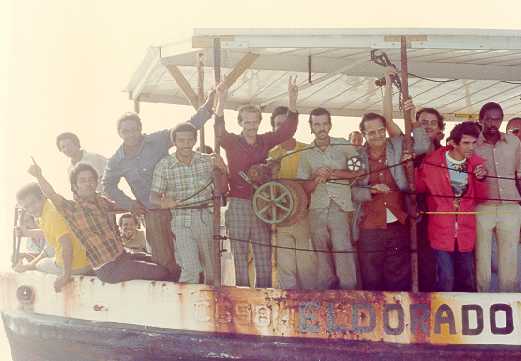 My rage only swelling, I wiped at the blood on my face and hurried back to my apartment. Tony was there. Tony was my mom’s boyfriend, at the time. He was a Marielito, coming over from Cuba during the Mariel boatlift. He claimed to have been a political prisoner, a master chess player who would have become a grandmaster if only he had pledged allegiance to the Communist Party. His lack of loyalty to the party had also kept him off the national baseball team, if he was to be believed. In truth, he was little more than a thug, a wannabe Scarface without the drive or the wits, only the propensity for paranoia and violence.
Tony hadn’t been able to hold down a regular job since getting to the states, so he mostly sponged off our family’s welfare benefits, only supplementing them with the occasional odd job. He loved to offer fatherly advice, in the form of Cuban proverbs. You knew your actions were about to be judged when he opened a sentence with the phrase, “Refran dice…” As far as I could tell, though, his favorite pastime was getting drunk with my mother on weekends and letting himself get drawn into an argument that would inevitably turn physical.
Tony saw the blood smeared across my face, but even before he could ask, I told him everything that had happened. He insisted I show him where the boy lived. I took him across the open quad that was surrounded by the two story buildings that made up our block of the apartment complex, then across the quad the next block over, to the apartment I had watched the kid enter. Tony beat on the door until a short, older woman answered, and he immediately cut into his broken English, so flawed that the only word that could be made out was the occasional sprinkling of “motherfucker.” The lady, obviously the boy’s mother, looked scared and confused. I jumped in and explained. She turned her head and hollered. “Billy!” He came to the door, and all that cockiness had dissolved into fear.
She introduced herself as Sue, and she made Billy apologize to me and promise not to harass my sister, again. It should’ve ended there, but it wasn’t long before school was over, and perhaps out of sheer proximity, Billy Cook had become my closest friend.
His family had cable, a luxury we couldn’t afford, then. I would go over to his house to watch videos on Mtv with him and Joe, his younger brother. He introduced me to his crew, a group of boys from families as broken as ours. Together, we would haunt the parking lot at the Mars Supermarket a couple of blocks from Riverdale Village. We would help people with their groceries, collecting quarters and the occasional dollar bills, until we could pool together enough money to afford a pack of cigarettes, a fifth of liquor, & enough Coke for us to chase it with. We’d have just enough left over to buy a few slices at the pizza shop and dump some quarters into the Ms. Pacman machine. If we got chased away from Mars, we would walk the quarter mile up the road to the Giant.
I wasn’t new to drinking. My mom was liberal enough to allow me the occasional sip of beer or wine, even the occasional shot of Bacardi. It wasn’t difficult for me to adapt to drinking regularly. I enjoyed the sensation. The numbness was preferable to how aware I often was that I didn’t fit in, that I was far from the place where I did, where you’d walk out of your home and straight into a wall of Disco, Salsa, or Hip Hop, sometimes all three colliding into a sonic wall of beautiful chaos. Drinking with my new friends was preferable to the drinking and violence I had to deal with at home. By the time I got home, walking off my buzz on the way, everyone would be in bed. I had missed any drama.
 In Riverdale Village, the soundtrack was heavy metal. We would ride around Middle River on our bikes—or in my case, not owning a bike, on the back of someone else’s—singing Ozzy, Scorpions, Iron Maiden at the top of our lungs. We would ride along the train tracks until we got to this wooded area where we could congregate, but stay invisible. We set coins on the track to see how flat they’d get. We’d build terrible forts that would fall apart, almost immediately. We fought.
I wasn’t the only small guy in our crew. There was a boy named Keith. He was the youngest, just having turned twelve. Keith was pale, with bright red, closely cropped hair. Despite being younger, Keith was still a tad bigger than me. Billy came up with the idea that the two smallest ones in the crew should fight, to see who was the most badass little guy. The fight didn’t last long. We exchanged a few blows until Keith caught me upside , the head, sending my glasses flying. Everything stopped. Everyone of us were in the same situation. We all knew how expensive it was to replace things like a pair of glasses when benefits only covered a new pair every other year.
“I can see! I can see!” I shouted. We all laughed. I bent over, picked up my glasses, inspected them enough to see there was no catastrophic damage, and put them back on. We were still laughing, with echoes of “I can see!” coming from the others, as we walked on to find something else to do.
I was led to believe we had rivals, crews from the neighboring towns, like Hawthorne and, of course, Essex, though I never saw them. Apparently, they took on the name of their respective towns. Not us. Middle River didn’t sound as cool as Middlesex. Middlesex wasn’t a even town so much as a business district. Just beyond the part of I-695 that went over Eastern Boulevard near the school, it divided Essex from Middle River. We did spent plenty of time there, especially at Skateland, the closest roller rink, where Billy taught me how to stay on my feet, and by the end of the summer, skate backwards. It’s also where the closest library was, where I’d spent plenty of time, before Billy.
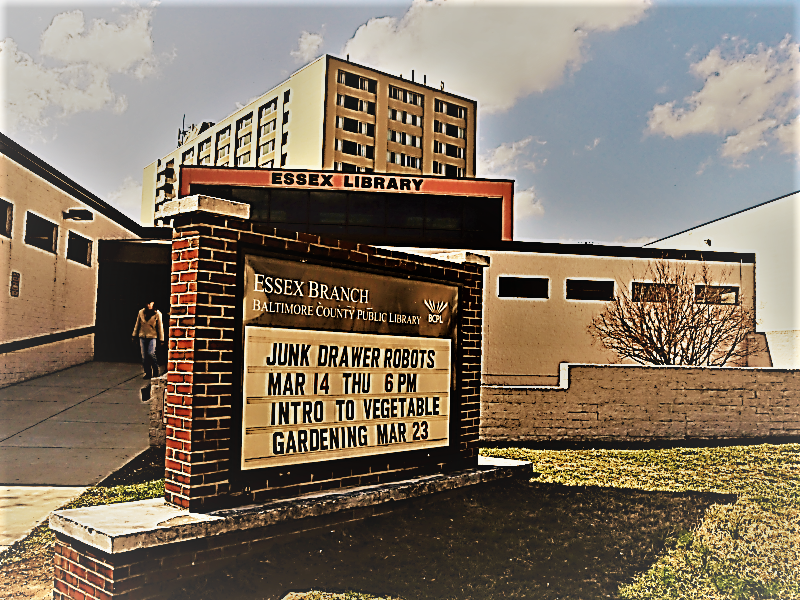 The closest I got to the library after was the time near the end of the summer when we were all supposed to meet up with a high school girl behind the library. She had promised to fuck us all. I was the only one of the group who was still a virgin, if you can believe the claims of a bunch of teen boys. It's unlikely I was the only one lying about it. I got as far as the shopping center, behind which was the library, before Billy pulled me aside.
“Listen, Freddy,” he said, “she said everyone’s okay, except for the one with glasses.” I was the only one in the group who needed glasses to see, at all. I got it. There was no point in my coming along.
“That’s fine,” I replied, “I’ll find something else to do.” I watched them walk behind the shopping center before I turned around to go home. On the walk home, I wondered if it had anything at all to do with the fact that I wore glasses, or if it had everything to do with the fact that I wasn’t white.
But times like those were few and far between. For the most part, Middlesex made me feel like I belonged. When I next saw them, they downplayed the encounter behind the library, telling me that she had smelled bad, so they just let her blow them before moving on. Once I developed a taste for hard rock and foreswore the WWF for the WCW, I was really no different. I might not be white, but at least I wasn’t black.
There were no black people in Middle River, at least none that I remember. Black folk were just the people we would hear about on the news, getting arrested for drugs and murder in Baltimore, about twenty minutes west of us down Eastern Boulevard. They were little more than rumors of race riots taking place after school in places like Patterson Park, instigated by black kids from notorious schools, like Hampstead Hill Jr High.
Despite my early upbringing in the diverse melting pot that is the New York Metropolitan area, I was not immune to racist thinking. Some of my mom’s closest friends were black. Hell, Puerto Ricans came in all shades! But my grandmother held a deep seated fear of non Hispanic Blacks, a fear that easily carried over to me as I watched the news and we discussed it among our crew. Blacks were taking over the city and taking the decent working class jobs away from whites. That’s what we were all taught. It came as no surprise that we wanted to cap off the summer by burning a cross at our school.
 We stood there, around our flaming cross, and I genuinely felt nothing. Not hate. Not fear. Just an inkling of guilt that I swallowed down with whiskey and chased with Coke when the bottle of Jack made it back to me. We stood there, until we saw the flashing blue lights pop up over Eastern Boulevard. We jumped the low fence that separated school property from the woods surrounding it and scattered.
School started up again that fall, but the partying never stopped. School became just what wasted time before I could be free to hang with the crew. In the fall, we volunteered to work at the haunted house at Cox Point, setting it up and taking roles as ghouls and zombies. As Christmas approached, we abandoned our grocery carrying enterprise in favor of singing Christmas carols door to door for cash. I was settling into everything except the my schoolwork, but I had become oblivious to my grades. My effort had become minimal, but it’s not like I cared enough to want to change.
And then I came home to find out that Tony had finally found a real job. In Baltimore.
We had been here barely a year, and we were moving, again—another new year, another new town, another new school. As I went around to each of my teachers to get my grades, it finally became apparent how much I had neglected my schoolwork. I was failing everything except English, Drama, and Art. I was barely passing English! I think I was lucky that Ms. Fleming, the English teacher was also my Drama teacher, that she had seen my potential for both, maybe. Or maybe she just felt sorry for me.
That Saturday, I had to force my goodbyes, not just to Middlesex, but everyone that I’d become acquainted with because of them: Billy’s older brother, Chuck, the most level headed of the Cook family, who once flew out of his apartment to smother a scarecrow we’d set on fire with a lighter and a can of hairspray; Tasha, the cute, blonde girl I’d had a crush on since moving to Middle River, who when I told her I was moving finally invited me into her apartment and gave me the most amazing kiss I’d ever had up until then; and of course, Sue Cook, who despite our less than hospitable introductions, treated me like a son.
The following Monday, as my family was barely settled into our tiny apartment on Pratt Street, two blocks from Patterson Park, my mom walked me through the main doors of the notorious Hampstead Hill Jr High, my new zoned school. I sat in the guidance office, head down, as Mr. Gregory reviewed my transcripts. I could feel him looking at me for what seemed like an inordinate amount of time before he finally spoke.
“You know what I’m looking at, right?” I nodded, sheepishly. “Let me tell you what I see. I see a kid who doesn’t look like these grades. I can’t imagine that these grades are who you really are. So, this is what we’re going to do. Since these grades aren’t you, we’re going to ignore them. We’re starting over, here. I think we’ll see the real you, soon enough.”
I fought to hold back tears all the way back home. Once I found some privacy, I set them free. I needed to start again, but there was no part of me that wanted to. I had sacrificed so much of myself to belong in Middlesex. Now, I was right back to feeling like ever belonging anywhere was just an illusion.
It was the first truly nice day of the year in 1982, one of those sunny, warm, early March days that preview the coming spring. I still had no friends. I was still the weird, non-white kid from Jersey who wore his snow boots until well after all the snow had melted, then replaced those with a pair of Sikes, counterfeit Nikes with the swoosh glued on upside down.
Having a pair Sikes may have been worse than wearing the ducks when there was no snow on the ground. I asked people start calling me Freddy in lieu of Fernando. It sounded more American in this place, Middle River, where I was the darkest skinned person, the closest being a girl of Native American descent. Besides, I couldn’t abide the twang that came out when the kids pronounced the nan in Fernando. Also, Freddy was the nickname everyone called my father, who had no idea we had even left Jersey, for good. Even then, I suspected I would never see him again. As much as anything else, it was a twelve-year-old’s way to honor his dad.
I decided that the day was too gorgeous to be spoiled by the fact I had no friends on that pre-spring Saturday. I slipped on my Sikes, picked a direction at random, and just started walking. For as much as I hated Middle River, it was beautiful. There were huge, wooded expanses and lush greenery everywhere. I found a creek and followed it.
I walked for what seemed miles, but I’m sure was far less, until I ran into someone I thought I recognized, a girl. “Freddy?” she called out to me with a smile. It was Kim from class at my new school, Stemmers Run Junior High. I didn’t know her well. A taller, thin wisp of girl who wore turquoise tortoise shell glasses. She had seemed shy, not exactly the girl I typically hung out with. But she was a friendly face, something I was desperate for. She invited me into her home, and I welcomed it.
She got me something to drink, and we went into her perfectly manicured back yard and talked a bit, about what I don’t completely remember.But I do remember that she was the first person to show an interest in who I was rather than what I was.
I’m sure I went on and on about Jersey, about all the friends I didn’t get a chance to say goodbye to, about my now dashed dream of studying acting at the New York School of Performing Arts—the so-called Fame school. Eventually, Kim asked me if I wanted to listen to some music.
So we lay on her lawn, looking at the wide, blue sky, listening to Elton John. The song Daniel was her favorite. Kim had an older brother named Daniel who she’d lost, and the song served as a tribute, a reminder of what she’d lost. By the time side A of Goodbye Yellow Brick Road was over we were holding hands. I felt compelled to kiss her. We hung out for a little while longer, holding hands, kissing; but by the end of the last side of the album, I felt ready to move on. I kissed her one last time before heading back home.
By the time the weekend was over and we’d returned to school, it was as if nothing had happened, as if we both knew we had just needed that moment to shake off the loneliness that had been plaguing us both—that it had been enough.
Things would fall apart quickly from that point on. I would soon begin to hang out with a group of troublemakers from my new home in the Riverdale Village apartment complex we’d moved to. I would spend the next nine months transforming from straight A student to an alcoholic, juvenile delinquent. I didn’t know then that I would nearly get arrested a few times, tag along for a gangbang behind Middlesex Library, only to be turned away once I got there—“not the one with the glasses,” the girl would say—I would even help burn a cross.
All that would come later. However, on that warm, late winter day in 1982, I just needed to feel like I belonged somewhere, again. For the briefest moment, Kim gave me exactly that. If only I had buried myself in that, in Kim’s kind offer of friendship, I might’ve avoided the dark spiral I was about to fall into.

Nike already ruled the world by 1982. Seeing the already ubiquitous swoosh on the box my mother pulled out of a shopping bag was the first fragment of hope I had felt since being dragged from the urban melting pot of Jersey City, New Jersey to the very white, barely suburban town of Middle River, Maryland. I say dragged because there was no choice. There was no discussion. There was only waking up one morning in January, and instead of going back to school after a dismal winter break, we packed all of our things that would fit in the car and drove south.
We had no warning. We didn’t even get a chance to say goodbye to our friends. My sister, my baby brother, and I were just suddenly yanked from everything and everyone we knew with no reasonable explanation I could recall. This was nothing new.
My mother was notorious for never staying in any one place for any lengthy period of time. We would come home from our usual summer vacation with my grandparents in Puerto Rico, and we’d already be moved into a new apartment, sometimes have to start fresh in a new school. What made this move unusual was that it was happening in the middle of a school year. For as erratic as my mother could be, she valued our education, and was usually careful not to disrupt that. Even more unusual was the choice to leave New Jersey.
Other than the lush, wild mountainsides that surrounded my grandparents’ home on the island my mother was born on, the streets of Hudson County were the only ones I’d ever known.
Union City, Jersey City, and Hoboken were never much different from each other, streets full of cheery people, the sounds of Disco and Salsa blending in the air, the aroma of Cuban and Puerto Rican food mingling just as easily. However often we moved, as long as we were in Hudson County, we were home. I had no idea, as we drove into Maryland on that gray December day, that I would be an adult with children of my own by the time I saw any part of Hudson County, again.
I didn’t even realize until we arrived at my godparent’s home in Owings Mills that we didn’t even have a place to stay, yet. We were stuck with them for a couple of weeks, Oscar, his second wife, Malinda, and their three unruly sons. They were hyperactive terrors, never disciplined until it was too late, until something had already been broken or someone had gotten hurt. All the boys were piled into their living room to sleep, so that my mother and sister could have some privacy in their boys’ bedroom. I use the term sleep loosely, as there wasn’t really much of it with our godbrothers’ ceaseless rambunctiousness. In this chaos, at least the picture of what was going on was now beginning to come together.
What was unsaid, at least to the children, but became apparent to me as the oldest at twelve, was that Oscar had moved to Maryland to avoid some trouble he’d gotten into in New Jersey. This was no surprise as I had eavesdropped on enough conversations to know that my godfather, the man who was supposed to take responsibility for me and my siblings if something happened to my mother, wasn’t much more than a petty criminal who sold drugs and guns to other petty criminals. Apparently, his escape turned into an opportunity to turn his life around in a mostly-white suburban Baltimore town.
This appealed to my mother who had long struggled with heroin addiction. Staying clean had become nearly impossible considering how prevalent drugs were on either side of the Hudson River, and how many connections she had that would sell, even give her drugs. Methadone was the closest thing she had to salvation, but couldn’t counteract the effects of a night of dancing and Studio 54. When you’re young and gorgeous and get drawn into the notorious VIP room in the basement, where you mingle with the biggest celebrities of the time, it’s not easy to say no to anything being offered.
I always appreciated my mother’s stories, like the time she saw Mick Jagger and David Bowie share an intimate kiss; but there were times when it would take my mother days to recover from a relapse. Even coming home in the early hours of the morning wasn’t always pretty. I recall one time waking up to being beaten because my mother, drunk, high, or both, thought I was faking sleep. I think the realization finally hit my mother, around the time Disco was dying, that her pattern of abuse and recovery, abuse and recovery, would likely end up killing her just as suddenly, especially at that time, with AIDS now throwing gasoline on the fire of her dangerous lifestyle.
Regardless to how clear the picture was becoming, my twelve-year-old mind, which had as good a grasp on my mother’s addiction as anyone my age could, could only feel resentment at the sudden change. My godfather didn’t make it any easier.
He took notice of how I disciplined my sister and brother. As the oldest kid in the household, considering my mother’s lifestyle, it naturally fell to me to pick up the slack. On days where my mother got home so late that she couldn’t get up the next morning, or on some rare occasions when she wouldn’t come home, at all, until much later, it was my responsibility to make sure my little sister and brother were fed and clean, got to school safely, did their homework, got to bed at a reasonable time. The lack of a parent had turned me into a parental figure, and my siblings gave me that respect.
So one night, in my godparents’ living room, when I snapped at my little brother, eight at the time, to hop down from an ottoman he was trying to stand on, Oscar very loudly pointed out to my mother that I should not be allowed to discipline my siblings. He felt that I held an unnatural control over them, and suspected that I was sexually molesting my little brother.
It wouldn’t be until years later that my sister would confide in me that it was Oscar who was the abuser. She let me know that he had taken to touching her inappropriately, whenever he could corner her alone, since she was eight; that the two weeks we ended spending at the Reyes’ home before we found a place of our own was an endless nightmare for her.
In that sense, we were all happy to pack the car up again and make our way to Middle River.
Middle River is another suburb of Baltimore, this one about 25 minutes east of the city. Unlike the middle class townhouses where my godparents lived, the best my mother could afford was a small apartment in a development called Riverdale Village. It seemed desolate, with the cold winter keeping everyone inside. It was nearly February before we finally got to meet other children as returning to school was delayed by a series of snowstorms that kicked of the year.
In a way, I was lucky there was so much snow on the ground. Somehow, in all the chaos, all my shoes had been lost. The only thing I had to put on my feet were my snow boots, a pair of ducks with a thick gray removable liner. They worked out fine for my first couple of weeks at Stemmer’s Run Junior High, but as the snow melted away and the weather warmed, question arose about why I was still wearing my ducks. “Don’t you have any Nikes?” one girl asked me, once. Honestly, I had no idea what she was talking about. Keds was all my mother could ever afford.
I had no answers about my shoes, although I imagine I must’ve had some response back then that I can no longer remember. I do remember letting my mother know that every day that I had to wear the boots was only becoming more and more embarrassing, that the only way to make up for this embarrassment--not to mention for the abrupt changes, for not getting a chance to say goodbye, for being forced to co-habitate with that horrible family for so long--the only thing that could make it all better was a pair of Nikes.
My mother had never held a legitimate job in her life, at least not any kind of job with regular hours and a steady paycheck. My mother was one of the Welfare Queens Ronald Reagan warned the country about when he first ran for president. What we couldn’t afford on welfare my mother supplemented as best she could, most commonly by having a working boyfriend move in with us. There was no working boyfriend in Middle River. Everything had to go to first month’s rent and the security deposit with a little left over so we didn’t start school without supplies.
You can imagine how excited I was when, after weeks of dread whenever I had to pull on my ducks every morning, I finally got a glimpse of the swoosh. I tore through the box, slipped them onto my feet, and kept them on only long enough to make sure they fit. They were perfect: white, all leather low tops with the white trim coming down over the toes, the slightly tapered white-walled sole trimmed in red, and that beautiful, matching red swoosh.
I was careful putting them on the next morning, careful walking to school. This was evidence that I wasn’t crazy or poor. A simple pair of tennis shoes would be what would finally help me fit in somewhere where no one had ever seen, much less heard of a Puerto Rican, where the only person that looked somewhat like me was native american, where there wasn’t even a black kid in the student body, where the sounds of salsa and disco had been supplanted by heavy metal and country.
I only realized how wrong I was when I ran into, Jon, one of my classmates. I tried to be subtle about it, not immediately calling attention to my new sneakers, or tenners as they called them there. I didn’t have to call attention to them. They drew attention all on their own. “What are you wearing?” Jon asked, with a strange tone in his voice.
Wasn’t it obvious? “My mom finally got me a pair of Nikes!” I announced proudly.
“Those aren’t Nikes!” he pointed out. “These are Nikes,” he said sticking one of his feet forward so I could get a better look. I looked at his kicks, then back at mine, and the truth suddenly became apparent. “Paul, come here!” he shouted to another of our classmates who hurried over. Both our shoes did indeed have the swoosh, but where his swooshed up, mine swooshed down.
“He says his mom got him Nikes, but they don’t really look like Nikes, do they?”
It only took Paul a quick glance to know. “Oh, those are fake Nikes. I don’t know who makes them, but I know what they’re called. Sikes!”
“Nice Sikes!” said Jon before dashing off with Paul, leaving me staring at my new shoes, alone in the emptying schoolyard.


